Introduction
Le PMOS / SOPK, longtemps appelé « syndrome des ovaires polykystiques », est un trouble hormonal et métabolique fréquent, souvent accompagné de symptômes déroutants. Il concerne environ 10 à 13 % des femmes en âge d’avoir des enfants1, et peut toucher le cycle, la fertilité, la peau, l’énergie et le moral.
Depuis mai 2026, il porte un nouveau nom : PMOS, pour « syndrome métabolique ovarien polyendocrinien »2. Je vous explique ce changement dans cet article.
Ce que beaucoup de femmes ignorent, c’est que des ajustements ciblés de l’alimentation et de l’hygiène de vie peuvent vraiment améliorer leur quotidien : les recommandations internationales les placent d’ailleurs en première ligne1. Je vis moi-même avec un PMOS / SOPK depuis 2019, et depuis 2020 j’accompagne des femmes concernées vers un mieux-être durable, en complément de leur suivi médical.
Comment reconnaître le PMOS / SOPK et obtenir un diagnostic fiable ?
Le diagnostic est posé par un médecin. Les recommandations internationales de 2023 s’appuient sur les critères de Rotterdam : il faut au moins deux des trois éléments suivants, une fois les autres causes possibles écartées1 :
- Des cycles irréguliers ou absents (ovulation rare ou absente) ;
- Un excès d’androgènes (hormones dites « masculines »), visible par des signes comme l’acné ou une pilosité excessive, ou mesuré par une prise de sang ;
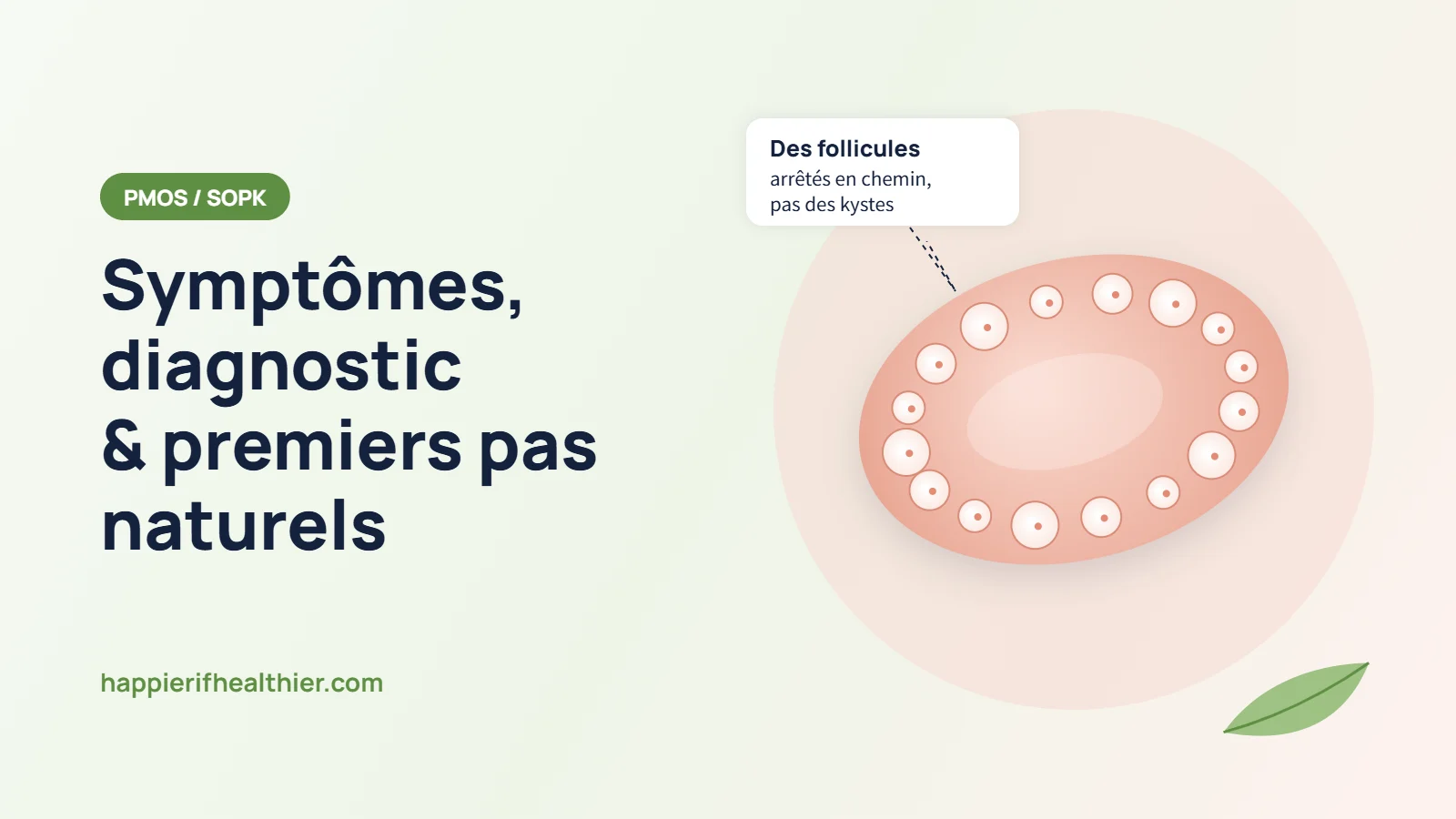
- Des ovaires d’aspect « multifolliculaire » à l’échographie : au moins 20 follicules par ovaire ou un volume ovarien d’au moins 10 ml. Chez l’adulte, un dosage sanguin de l’AMH peut remplacer l’échographie1.
💡 Chez les adolescentes (moins de 8 ans après les premières règles), l’échographie n’est pas utilisée pour le diagnostic, car beaucoup de follicules sont normaux à cet âge1.
Les 4 profils (phénotypes)
Selon la combinaison des critères, on distingue quatre profils3 :
- Profil A, « complet » : cycles irréguliers + excès d’androgènes + ovaires multifolliculaires ;
- Profil B, « classique » : cycles irréguliers + excès d’androgènes, ovaires d’aspect normal ;
- Profil C, « ovulatoire » : excès d’androgènes + ovaires multifolliculaires, cycles réguliers ;
- Profil D, « sans excès d’androgènes » : cycles irréguliers + ovaires multifolliculaires.
👉 Les profils A et B sont en général associés à un risque métabolique plus élevé : résistance à l’insuline, diabète de type 2, cholestérol, santé cardiovasculaire3.
💡 Le poids n’est pas un critère de diagnostic. Beaucoup de femmes minces vivent avec un PMOS / SOPK sans le savoir, car on associe encore trop souvent ce syndrome au surpoids.
Les symptômes fréquents
- Cycles irréguliers, espacés ou absents ;
- Prise de poids ou difficulté à perdre du poids ;
- Pilosité excessive (hirsutisme), surtout au visage, au menton ou sur le ventre ;
- Chute de cheveux sur le dessus de la tête ;
- Peau grasse, acné persistante ;
- Taches brunes et veloutées (cou, aisselles, aine), un signe possible de résistance à l’insuline ;
- Fatigue, troubles du sommeil ;
- Anxiété, baisse de moral : ils sont plus fréquents chez les femmes concernées et méritent d’être pris au sérieux1.
Chaque femme vit le PMOS / SOPK différemment : on peut avoir un seul de ces signes, ou plusieurs.
D’où vient-il ?
Les causes exactes ne sont pas encore toutes connues, mais plusieurs facteurs se combinent1,3 :
- La génétique : le syndrome est souvent présent chez plusieurs femmes d’une même famille ;
- La résistance à l’insuline : le corps répond moins bien à l’insuline, qui augmente alors et pousse les ovaires à produire plus d’androgènes ;
- Une inflammation de bas grade, souvent retrouvée dans les études ;
- L’hygiène de vie (alimentation, sédentarité, stress, sommeil), qui ne cause pas le syndrome à elle seule mais peut aggraver ou apaiser les symptômes.
Les premiers pas naturels
Voici les bases sur lesquelles je travaille avec les femmes que j’accompagne, en accord avec les recommandations internationales1 :
- Stabiliser la glycémie : des protéines et des fibres à chaque repas, des glucides complets plutôt que raffinés, moins de boissons sucrées ;
- Bouger régulièrement : au moins 150 minutes d’activité modérée par semaine, avec du renforcement musculaire si possible ;
- Prendre soin du sommeil et du stress, qui influencent directement l’équilibre hormonal ;
- Les compléments (inositol, vitamine D, oméga-3…) peuvent avoir leur place, mais les preuves sont encore limitées pour certains : ils se choisissent au cas par cas, idéalement après un bilan avec votre médecin1.
Envie de faire le premier pas ? Faites le quiz PMOS / SOPK gratuit, rejoignez ma communauté Facebook où je partage des conseils pratiques, ou réservez une séance.
Envie d’être accompagnée sur votre équilibre hormonal ?
Lors d’une séance Équilibre hormonal (45 min en visio), nous faisons le point sur votre cycle, votre énergie et votre alimentation, et je vous propose un plan simple et personnalisé.
Cet article est informatif. Il ne remplace pas l’avis de votre médecin, qui reste votre interlocuteur pour le diagnostic et le traitement.
Sources
- Teede HJ, Tay CT, Laven JSE, et al. Recommendations from the 2023 International Evidence-based Guideline for the Assessment and Management of Polycystic Ovary Syndrome. Human Reproduction, 2023;38(9):1655–1679.
- Teede HJ, Khomami MB, Morman R, et al. Polyendocrine metabolic ovarian syndrome, the new name for polycystic ovary syndrome: a multistep global consensus process. The Lancet, 2026. Lire l’article
- Joham AE, Norman RJ, Stener-Victorin E, et al. Polycystic ovary syndrome. The Lancet Diabetes & Endocrinology, 2022;10(9):668–680.
Introduction
PMOS / PCOS, long known as “polycystic ovary syndrome”, is a common hormonal and metabolic condition, often with confusing symptoms. It affects about 10 to 13% of women of reproductive age1, and can affect the cycle, fertility, skin, energy and mood.
Since May 2026, it has a new name: PMOS, for “Polyendocrine Metabolic Ovarian Syndrome”2. I explain this change in this article.
What many women don’t know is that targeted changes to diet and lifestyle can really improve daily life: the international guidelines put them first1. I have been living with PMOS / PCOS myself since 2019, and since 2020 I have been supporting women with the condition towards lasting wellbeing, alongside their medical care.
How to recognise PMOS / PCOS and get a reliable diagnosis
The diagnosis is made by a doctor. The 2023 international guidelines rely on the Rotterdam criteria: at least two of the following three, once other possible causes have been ruled out1:
- Irregular or absent cycles (rare or absent ovulation);
- Excess androgens (so-called “male” hormones), seen through signs such as acne or excess hair, or measured in a blood test;
- “Multifollicular” ovaries on ultrasound: at least 20 follicles per ovary or an ovarian volume of at least 10 ml. In adults, an AMH blood test can replace the ultrasound1.
💡 In teenagers (less than 8 years after their first period), ultrasound is not used for diagnosis, because many follicles are normal at that age1.
The 4 profiles (phenotypes)
Depending on the combination of criteria, there are four profiles3:
- Profile A, “complete”: irregular cycles + excess androgens + multifollicular ovaries;
- Profile B, “classic”: irregular cycles + excess androgens, normal-looking ovaries;
- Profile C, “ovulatory”: excess androgens + multifollicular ovaries, regular cycles;
- Profile D, “non-androgenic”: irregular cycles + multifollicular ovaries.
👉 Profiles A and B are generally linked to a higher metabolic risk: insulin resistance, type 2 diabetes, cholesterol, heart health3.
💡 Weight is not a diagnostic criterion. Many slim women live with PMOS / PCOS without knowing it, because the syndrome is still too often associated with being overweight.
Common symptoms
- Irregular, infrequent or absent periods;
- Weight gain or difficulty losing weight;
- Excess hair (hirsutism), especially on the face, chin or tummy;
- Hair thinning on the top of the head;
- Oily skin, persistent acne;
- Dark, velvety patches (neck, armpits, groin), a possible sign of insulin resistance;
- Fatigue, sleep problems;
- Anxiety, low mood: they are more common in women with the condition and deserve to be taken seriously1.
Every woman experiences PMOS / PCOS differently: you may have just one of these signs, or several.
Where does it come from?
The exact causes are not all known yet, but several factors combine1,3:
- Genetics: the syndrome often runs in families;
- Insulin resistance: the body responds less well to insulin, which then rises and pushes the ovaries to produce more androgens;
- Low-grade inflammation, often found in studies;
- Lifestyle (diet, inactivity, stress, sleep), which does not cause the syndrome on its own but can worsen or ease the symptoms.
First natural steps
Here are the foundations I work on with the women I support, in line with the international guidelines1:
- Stabilise blood sugar: protein and fibre at every meal, whole rather than refined carbohydrates, fewer sugary drinks;
- Move regularly: at least 150 minutes of moderate activity a week, with strength training if possible;
- Look after sleep and stress, which directly influence hormonal balance;
- Supplements (inositol, vitamin D, omega-3…) can have their place, but evidence is still limited for some: they are chosen case by case, ideally after tests with your doctor1.
Ready to take the first step? Take the free PMOS / PCOS quiz, join my Facebook community where I share practical tips, or book a session.
This article is for information only. It does not replace the advice of your doctor, who remains your contact for diagnosis and treatment.
Sources
- Teede HJ, Tay CT, Laven JSE, et al. Recommendations from the 2023 International Evidence-based Guideline for the Assessment and Management of Polycystic Ovary Syndrome. Human Reproduction, 2023;38(9):1655–1679.
- Teede HJ, Khomami MB, Morman R, et al. Polyendocrine metabolic ovarian syndrome, the new name for polycystic ovary syndrome: a multistep global consensus process. The Lancet, 2026. Read the article
- Joham AE, Norman RJ, Stener-Victorin E, et al. Polycystic ovary syndrome. The Lancet Diabetes & Endocrinology, 2022;10(9):668–680.
مقدمة
PMOS / SOPK، الذي عُرف طويلًا باسم « متلازمة تكيّس المبايض »، اضطراب هرموني وأيضي شائع، غالبًا ما تصاحبه أعراض محيّرة. يمسّ حوالي 10 إلى 13 % من النساء في سن الإنجاب1، وقد يؤثر على الدورة والخصوبة والبشرة والطاقة والمزاج.
منذ مايو 2026، أصبح يحمل اسمًا جديدًا: PMOS، أي « المتلازمة المبيضية الأيضية متعددة الغدد الصماء »2. أشرح لكِ هذا التغيير في هذا المقال.
ما تجهله كثير من النساء أن تعديلات مدروسة في التغذية ونمط الحياة يمكن أن تحسّن حياتهن اليومية فعلًا، بل إن التوصيات الدولية تضعها في المقام الأول1. أعيش أنا أيضًا مع PMOS / SOPK منذ 2019، ومنذ 2020 أرافق النساء المعنيات نحو راحة دائمة، كمكمّل لمتابعتهن الطبية.
كيف نتعرّف على PMOS / SOPK ونحصل على تشخيص موثوق؟
يضع الطبيب التشخيص. وتعتمد التوصيات الدولية لسنة 2023 على معايير روتردام: يجب توفّر عنصرين على الأقل من العناصر الثلاثة التالية، بعد استبعاد الأسباب الأخرى المحتملة1:
- دورة غير منتظمة أو غائبة (إباضة نادرة أو غائبة)؛
- زيادة في الأندروجينات (الهرمونات « الذكورية »)، تظهر في علامات مثل حب الشباب أو الشعر الزائد، أو تُقاس بتحليل الدم؛
- مبايض « متعددة الجُريبات » في الفحص بالصدى: 20 جُريبًا على الأقل في كل مبيض أو حجم مبيض لا يقل عن 10 مل. لدى البالغات، يمكن لتحليل AMH في الدم أن يعوّض الفحص بالصدى1.
💡 لدى المراهقات (أقل من 8 سنوات بعد أول دورة)، لا يُستعمل الفحص بالصدى في التشخيص، لأن كثرة الجُريبات طبيعية في هذا السن1.
الأنماط الأربعة
حسب اجتماع المعايير، نميّز أربعة أنماط3:
- النمط A، « الكامل »: دورة غير منتظمة + زيادة الأندروجينات + مبايض متعددة الجُريبات؛
- النمط B، « الكلاسيكي »: دورة غير منتظمة + زيادة الأندروجينات، مبايض طبيعية المظهر؛
- النمط C، « الإباضي »: زيادة الأندروجينات + مبايض متعددة الجُريبات، دورة منتظمة؛
- النمط D، « بدون زيادة الأندروجينات »: دورة غير منتظمة + مبايض متعددة الجُريبات.
👉 النمطان A وB يرتبطان عمومًا بخطر أيضي أعلى: مقاومة الإنسولين، السكري من النوع 2، الكوليسترول، صحة القلب3.
💡 الوزن ليس معيارًا للتشخيص. كثير من النساء النحيفات يعشن مع PMOS / SOPK دون أن يعلمن، لأن هذه المتلازمة ما زالت تُربط كثيرًا بالوزن الزائد.
الأعراض الشائعة
- دورة غير منتظمة أو متباعدة أو غائبة؛
- زيادة الوزن أو صعوبة فقدانه؛
- شعر زائد، خاصة في الوجه أو الذقن أو البطن؛
- خفّة الشعر في أعلى الرأس؛
- بشرة دهنية وحب شباب مستمر؛
- بقع داكنة مخملية (العنق، الإبطان، الفخذان)، وهي علامة محتملة لمقاومة الإنسولين؛
- تعب واضطرابات في النوم؛
- قلق وانخفاض في المزاج: هما أكثر شيوعًا لدى النساء المعنيات ويستحقان الاهتمام1.
كل امرأة تعيش PMOS / SOPK بطريقتها: قد تظهر لديكِ علامة واحدة فقط، أو عدة علامات.
من أين يأتي؟
الأسباب الدقيقة ليست كلها معروفة بعد، لكن عدة عوامل تجتمع1,3:
- الوراثة: كثيرًا ما توجد المتلازمة لدى عدة نساء من العائلة نفسها؛
- مقاومة الإنسولين: يستجيب الجسم بشكل أضعف للإنسولين، فيرتفع ويدفع المبايض إلى إنتاج المزيد من الأندروجينات؛
- التهاب منخفض الدرجة، يُلاحظ كثيرًا في الدراسات؛
- نمط الحياة (التغذية، قلة الحركة، التوتر، النوم)، الذي لا يسبّب المتلازمة وحده، لكنه قد يزيد الأعراض أو يخفّفها.
الخطوات الطبيعية الأولى
إليكِ الأسس التي أعمل عليها مع النساء اللواتي أرافقهن، وفقًا للتوصيات الدولية1:
- تثبيت سكر الدم: بروتين وألياف في كل وجبة، نشويات كاملة بدل المكرّرة، ومشروبات سكرية أقل؛
- الحركة بانتظام: 150 دقيقة على الأقل من النشاط المعتدل أسبوعيًا، مع تقوية العضلات إن أمكن؛
- الاعتناء بالنوم والتوتر، لأنهما يؤثران مباشرة على التوازن الهرموني؛
- المكمّلات (الإينوزيتول، فيتامين د، أوميغا 3…) قد يكون لها مكان، لكن الأدلة ما زالت محدودة بالنسبة لبعضها: تُختار حالة بحالة، ويُفضّل بعد تحاليل مع طبيبكِ1.
تريدين أن تخطي الخطوة الأولى؟ جرّبي الاختبار المجاني، انضمي إلى مجموعتي على فيسبوك حيث أشارك نصائح عملية، أو احجزي جلسة.
هذا المقال للإعلام فقط، ولا يعوّض رأي طبيبكِ، الذي يبقى المرجع في التشخيص والعلاج.
المصادر
- Teede HJ, Tay CT, Laven JSE, et al. Recommendations from the 2023 International Evidence-based Guideline for the Assessment and Management of Polycystic Ovary Syndrome. Human Reproduction, 2023;38(9):1655–1679.
- Teede HJ, Khomami MB, Morman R, et al. Polyendocrine metabolic ovarian syndrome, the new name for polycystic ovary syndrome: a multistep global consensus process. The Lancet, 2026. اقرئي المقال
- Joham AE, Norman RJ, Stener-Victorin E, et al. Polycystic ovary syndrome. The Lancet Diabetes & Endocrinology, 2022;10(9):668–680.

