Temps de lecture : 5 minutes
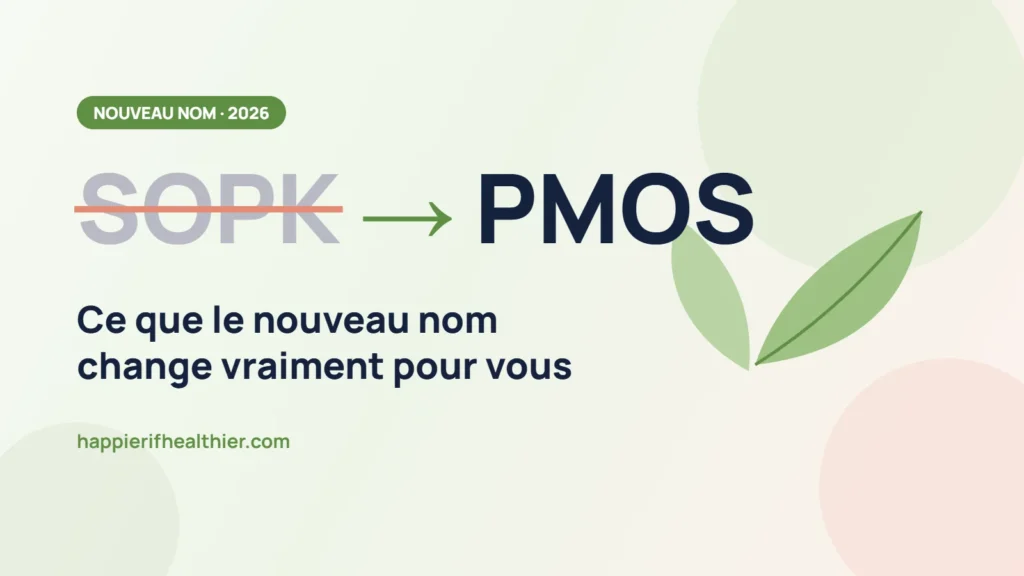
Vous avez peut-être vu passer l’information : le SOPK change de nom. En mai 2026, un consortium international de médecins, de chercheurs et de patientes a annoncé dans la revue The Lancet que le « syndrome des ovaires polykystiques » s’appelle désormais PMOS, pour Polyendocrine Metabolic Ovarian Syndrome. En français, on parle de SMOP : syndrome métabolique ovarien polyendocrinien1,2.
Simple changement d’étiquette ? Pas du tout. Ce nouveau nom dit enfin ce que beaucoup d’entre nous vivent depuis des années : ce syndrome ne se résume pas aux ovaires. Je vous explique simplement ce qui change, et surtout ce que cela veut dire pour vous au quotidien.
Pourquoi l’ancien nom posait problème
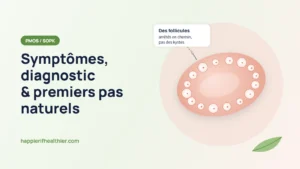
« Polykystique » laisse penser qu’on a des kystes sur les ovaires. En réalité, ce qu’on voit à l’échographie, ce sont des follicules (de petits sacs qui contiennent un ovule) qui se sont arrêtés en cours de développement. Ce ne sont pas des kystes malades1. Et certaines femmes concernées n’en ont pas du tout.
Selon les auteurs, ce nom trompeur a contribué à :
- des diagnostics tardifs ou contradictoires (on cherche des kystes, on n’en trouve pas, on passe à côté) ;
- une prise en charge morcelée, centrée uniquement sur le cycle et la fertilité ;
- une stigmatisation et beaucoup d’incompréhension chez les femmes concernées1,3.
Ce que dit le nouveau nom, mot par mot
- Polyendocrine : plusieurs hormones sont touchées à la fois (androgènes, insuline, hormones du cycle).
- Métabolique : le syndrome agit sur la façon dont le corps gère le sucre et les graisses : résistance à l’insuline, prise de poids, risque cardio-métabolique.
- Ovarien : l’ovulation est perturbée, ce qui explique les cycles irréguliers et parfois les difficultés à concevoir3.
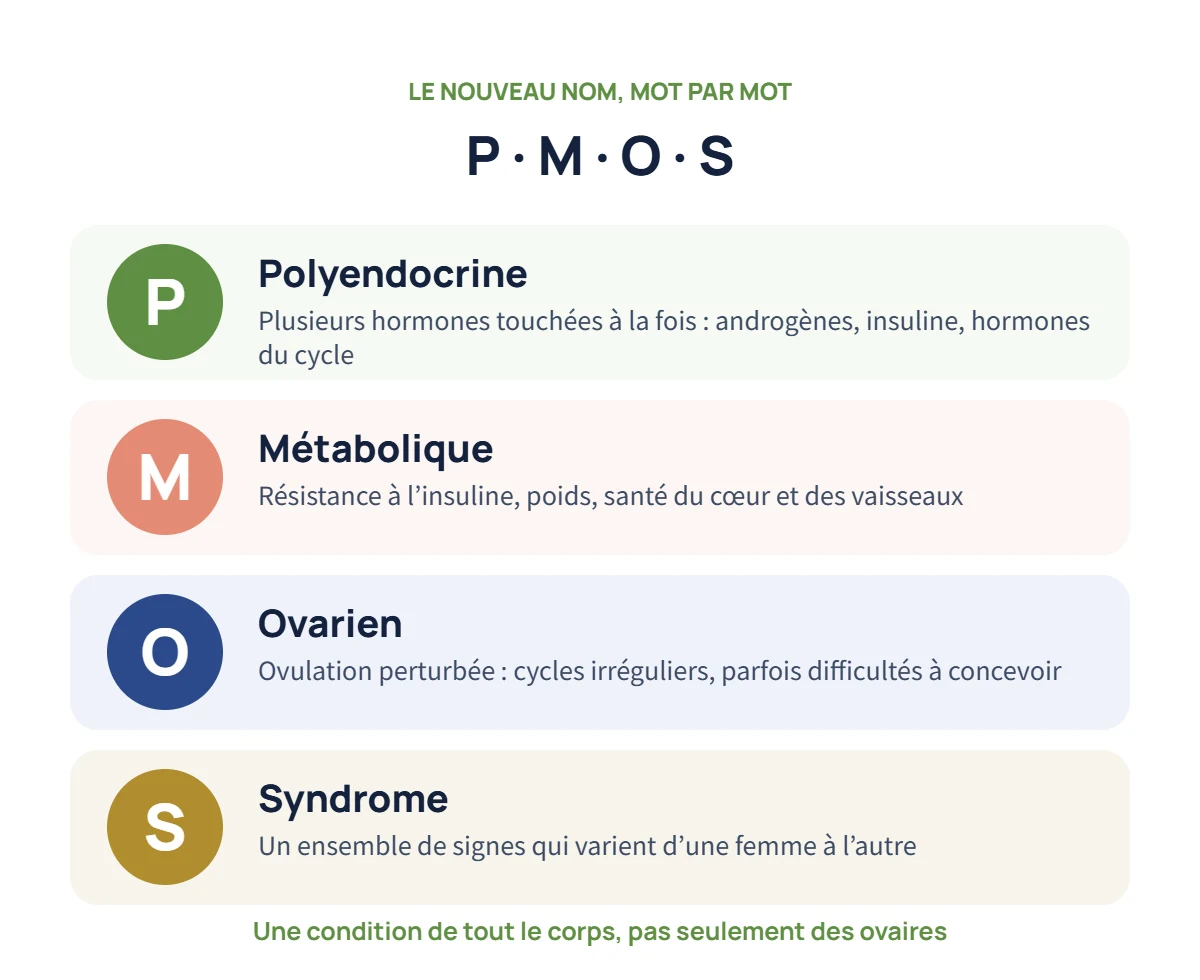
Autrement dit, c’est une condition de tout le corps, qui peut toucher la peau, le poids, l’énergie, l’humeur et la santé à long terme, et pas seulement les règles.
Comment ce nom a été choisi
Ce n’est pas une décision prise à la légère. Le processus a duré environ 14 ans. Plus de 14 300 personnes (des femmes concernées et des professionnels de santé de toutes les régions du monde) ont répondu à plusieurs vagues de questionnaires, et 56 organisations académiques, médicales et de patientes y ont participé1,3. Le travail a été coordonné par l’équipe de la Pr Helena Teede (Université Monash, Australie), qui dirige aussi les recommandations internationales sur ce syndrome.
Qu’est-ce qui change concrètement pour vous ?
Le diagnostic, lui, ne change pas. Seul le nom évolue. Une période de transition de 3 ans est prévue, le temps que les médecins, les dossiers médicaux et les classifications internationales s’adaptent3. Vous entendrez donc encore « SOPK » pendant un moment. C’est pour cela que j’écris « PMOS / SOPK » sur ce site.
Ce qui change, c’est le regard porté sur le syndrome. Les spécialistes encouragent à le voir comme une condition métabolique et inflammatoire de long terme, et à surveiller davantage la glycémie, le cholestérol et la santé cardiovasculaire2. C’est une bonne nouvelle : on ne s’occupe plus seulement de « faire revenir les règles », on prend soin de votre santé globale.
Ce que ça confirme : l’hygiène de vie compte vraiment
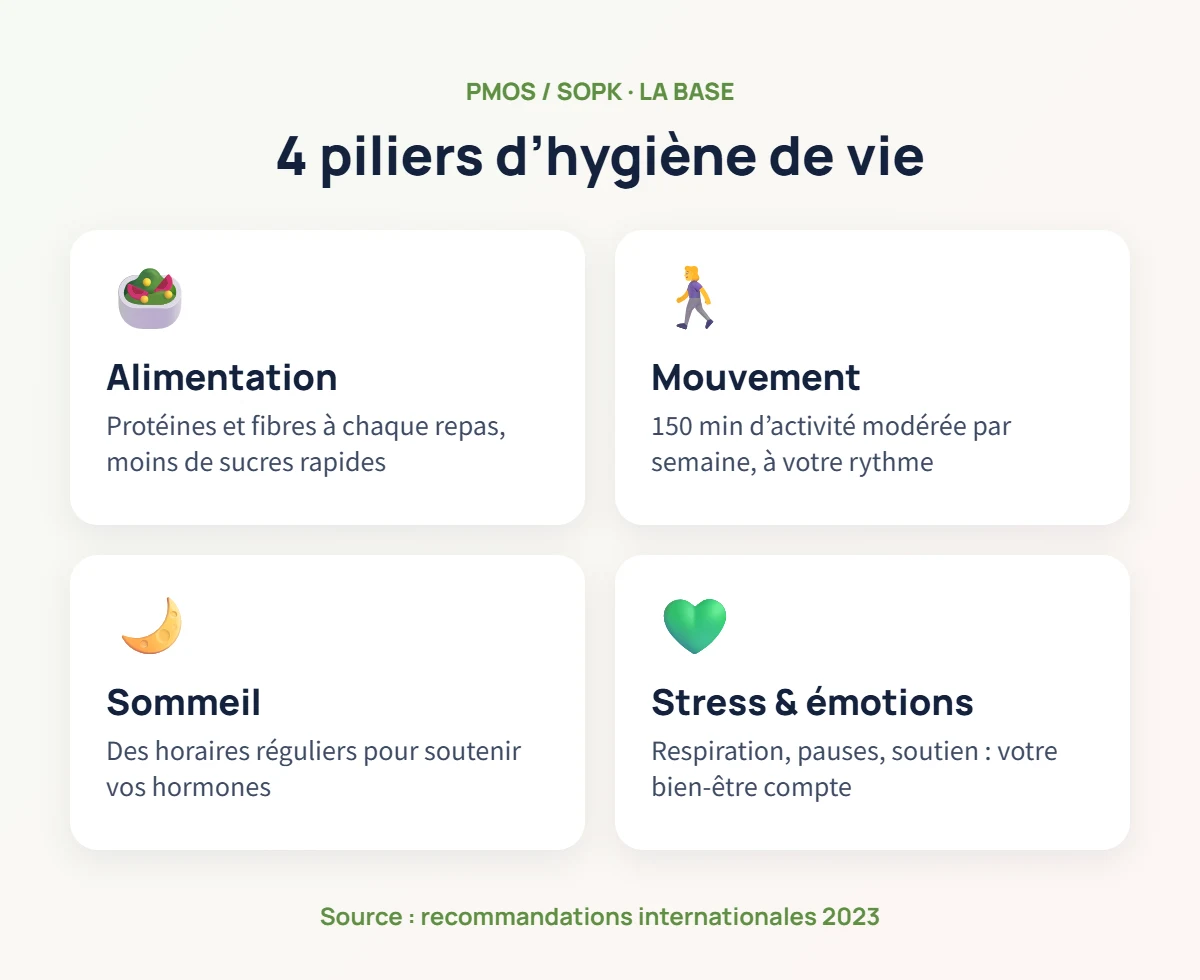
Si le syndrome est en grande partie métabolique, alors ce que vous faites au quotidien a un vrai impact. Les recommandations internationales de 2023 placent d’ailleurs l’hygiène de vie en première ligne, pour toutes les femmes concernées, quel que soit leur poids4 :
- Une alimentation équilibrée, qui stabilise la glycémie : des protéines et des fibres à chaque repas, moins de sucres rapides.
- Le mouvement : les recommandations parlent d’au moins 150 minutes d’activité modérée par semaine, et chaque petit pas compte.
- Le sommeil, le stress et le bien-être émotionnel, qui font partie intégrante de la prise en charge.
- Chez les femmes en surpoids, une perte de 5 à 10 % du poids peut déjà améliorer les cycles et les marqueurs métaboliques4.
Je vis moi-même avec un PMOS / SOPK depuis 2019. Ce nouveau nom, je l’ai pris comme une reconnaissance : oui, c’est tout le corps qui est concerné, et oui, on peut agir sur beaucoup de choses.
Hafida
En résumé
- Le SOPK s’appelle désormais PMOS (SMOP en français).
- Le nouveau nom reflète une condition hormonale et métabolique, pas seulement ovarienne.
- Le diagnostic ne change pas, la transition durera 3 ans.
- L’alimentation, le mouvement, le sommeil et la gestion du stress restent la base.
Vous vous demandez où vous en êtes ? Faites le quiz PMOS / SOPK gratuit en 2 minutes, ou réservez une séance Équilibre hormonal pour en parler ensemble.
Envie d’être accompagnée sur votre équilibre hormonal ?
Lors d’une séance Équilibre hormonal (45 min en visio), nous faisons le point sur votre cycle, votre énergie et votre alimentation, et je vous propose un plan simple et personnalisé.
Cet article est informatif. Il ne remplace pas l’avis de votre médecin, qui reste votre interlocuteur pour le diagnostic et le traitement.
Sources
- Teede HJ, Khomami MB, Morman R, et al. Polyendocrine metabolic ovarian syndrome, the new name for polycystic ovary syndrome: a multistep global consensus process. The Lancet, publié en ligne le 12 mai 2026. Lire l’article
- Medical News Today. From PCOS to PMOS: how the name change is set to improve diagnosis and care, 13 mai 2026. Lire ; La Revue du Praticien. Le SOPK devient SMOP. Lire
- Contemporary OB/GYN. Global consensus renames PCOS to polyendocrine metabolic ovarian syndrome (PMOS), 2026. Lire
- Teede HJ, Tay CT, Laven JSE, et al. Recommendations from the 2023 International Evidence-based Guideline for the Assessment and Management of Polycystic Ovary Syndrome. Human Reproduction, 2023;38(9):1655–1679.
Reading time: 5 minutes
You may have seen the news: PCOS has a new name. In May 2026, an international consortium of doctors, researchers and patients announced in The Lancet that “polycystic ovary syndrome” is now called PMOS, for Polyendocrine Metabolic Ovarian Syndrome1,2.
Just a new label? Not at all. This new name finally says what many of us have lived with for years: this syndrome is not only about the ovaries. Here is, simply, what changes, and above all what it means for you day to day.
Why the old name was a problem
“Polycystic” suggests you have cysts on your ovaries. In reality, what we see on ultrasound are follicles (small sacs containing an egg) that stopped developing along the way. They are not diseased cysts1. And some women with the condition have none at all.
According to the authors, this misleading name contributed to:
- late or conflicting diagnoses (looking for cysts, not finding any, missing the condition);
- fragmented care, focused only on the cycle and fertility;
- stigma and a lot of confusion for the women concerned1,3.
What the new name says, word by word
- Polyendocrine: several hormones are affected at once (androgens, insulin, cycle hormones).
- Metabolic: the syndrome affects how the body handles sugar and fat: insulin resistance, weight gain, cardiometabolic risk.
- Ovarian: ovulation is disrupted, which explains irregular cycles and sometimes difficulty conceiving3.
In other words, it is a whole-body condition, which can affect skin, weight, energy, mood and long-term health, not just periods.
How the name was chosen
This was not a decision taken lightly. The process took about 14 years. More than 14,300 people (women with the condition and health professionals from every region of the world) answered several rounds of questionnaires, and 56 academic, medical and patient organisations took part1,3. The work was led by Professor Helena Teede’s team (Monash University, Australia), which also leads the international guidelines on this syndrome.
What actually changes for you?
The diagnosis itself does not change. Only the name does. A 3-year transition period is planned, so that doctors, medical records and international classifications can adapt3. You will still hear “PCOS” for a while. That is why I write “PMOS / PCOS” on this website.
What changes is how the syndrome is seen. Specialists encourage viewing it as a long-term metabolic and inflammatory condition, and checking blood sugar, cholesterol and heart health more closely2. That is good news: the goal is no longer just to “bring periods back”, but to care for your overall health.
What it confirms: lifestyle really matters
If the syndrome is largely metabolic, then what you do every day has a real impact. The 2023 international guidelines put lifestyle first, for all women with the condition, whatever their weight4:
- A balanced diet that stabilises blood sugar: protein and fibre at every meal, fewer fast sugars.
- Movement: the guidelines recommend at least 150 minutes of moderate activity a week, and every small step counts.
- Sleep, stress and emotional wellbeing, which are an integral part of care.
- For women who are overweight, losing 5 to 10% of body weight can already improve cycles and metabolic markers4.
I have been living with PMOS / PCOS myself since 2019. I took this new name as recognition: yes, the whole body is involved, and yes, we can act on many things.
Hafida
In short
- PCOS is now called PMOS.
- The new name reflects a hormonal and metabolic condition, not just an ovarian one.
- The diagnosis does not change; the transition will last 3 years.
- Diet, movement, sleep and stress management remain the foundation.
Wondering where you stand? Take the free PMOS / PCOS quiz in 2 minutes, or book a Hormonal balance session to talk it through together.
This article is for information only. It does not replace the advice of your doctor, who remains your contact for diagnosis and treatment.
Sources
- Teede HJ, Khomami MB, Morman R, et al. Polyendocrine metabolic ovarian syndrome, the new name for polycystic ovary syndrome: a multistep global consensus process. The Lancet, published online 12 May 2026. Read
- Medical News Today. From PCOS to PMOS: how the name change is set to improve diagnosis and care, 13 May 2026. Read
- Contemporary OB/GYN. Global consensus renames PCOS to polyendocrine metabolic ovarian syndrome (PMOS), 2026. Read
- Teede HJ, Tay CT, Laven JSE, et al. Recommendations from the 2023 International Evidence-based Guideline for the Assessment and Management of Polycystic Ovary Syndrome. Human Reproduction, 2023;38(9):1655–1679.
مدة القراءة: 5 دقائق
ربما سمعتِ الخبر: متلازمة تكيّس المبايض غيّرت اسمها. في مايو 2026، أعلن تحالف دولي من الأطباء والباحثين والمريضات في مجلة The Lancet أن « متلازمة المبايض المتعددة الكيسات » أصبحت تُسمّى PMOS، أي المتلازمة المبيضية الأيضية متعددة الغدد الصماء1,2.
مجرّد تغيير في التسمية؟ أبدًا. هذا الاسم الجديد يقول أخيرًا ما تعيشه الكثيرات منّا منذ سنوات: هذه المتلازمة لا تقتصر على المبايض. أشرح لكِ ببساطة ما الذي تغيّر، وخاصة ما يعنيه ذلك في حياتكِ اليومية.
لماذا كان الاسم القديم مشكلة
كلمة « متعددة الكيسات » توحي بوجود أكياس على المبايض. في الواقع، ما نراه في الفحص بالصدى هو جُريبات (أكياس صغيرة تحتوي على بويضة) توقّف نموّها في منتصف الطريق. ليست أكياسًا مرضية1. وبعض النساء المعنيات لا توجد لديهن أصلًا.
حسب الباحثين، ساهم هذا الاسم المضلِّل في:
- تشخيص متأخر أو متناقض (نبحث عن أكياس، لا نجدها، فيفوتنا التشخيص)؛
- متابعة مجزّأة تركّز فقط على الدورة والخصوبة؛
- وصمة وكثير من سوء الفهم لدى النساء المعنيات1,3.
ما يقوله الاسم الجديد، كلمة بكلمة
- متعددة الغدد الصماء: عدة هرمونات تتأثر في الوقت نفسه (الأندروجينات، الإنسولين، هرمونات الدورة).
- أيضية: تؤثر المتلازمة على طريقة تعامل الجسم مع السكر والدهون: مقاومة الإنسولين، زيادة الوزن، خطر على القلب والأيض.
- مبيضية: الإباضة مضطربة، مما يفسّر الدورة غير المنتظمة وأحيانًا صعوبة الحمل3.
بعبارة أخرى، إنها حالة تخصّ الجسم كله، وقد تؤثر على البشرة والوزن والطاقة والمزاج والصحة على المدى الطويل، وليس فقط على الدورة.
كيف اختير هذا الاسم
لم يكن قرارًا متسرّعًا. استمرت العملية حوالي 14 سنة. أجاب أكثر من 14 300 شخص (نساء معنيات ومهنيون صحيون من كل مناطق العالم) على عدة جولات من الاستبيانات، وشاركت 56 منظمة أكاديمية وطبية ومنظمات للمريضات1,3. نسّق هذا العمل فريق البروفيسورة هيلينا تيدي (جامعة موناش، أستراليا)، الذي يقود أيضًا التوصيات الدولية حول هذه المتلازمة.
ما الذي يتغيّر فعليًا بالنسبة لكِ؟
التشخيص نفسه لا يتغيّر. الاسم فقط هو الذي يتطوّر. هناك فترة انتقالية مدتها 3 سنوات حتى يتأقلم الأطباء والملفات الطبية والتصنيفات الدولية3. لذلك ستسمعين « SOPK » أو « تكيّس المبايض » لبعض الوقت، ولهذا أكتب « PMOS / SOPK » في هذا الموقع.
ما يتغيّر هو النظرة إلى المتلازمة. يشجّع المختصون على اعتبارها حالة أيضية والتهابية طويلة الأمد، وعلى مراقبة سكر الدم والكوليسترول وصحة القلب أكثر2. وهذا خبر جيد: لم يعد الهدف فقط « إرجاع الدورة »، بل الاعتناء بصحتكِ الشاملة.
ما يؤكّده هذا الاسم: نمط الحياة مهم حقًا
إذا كانت المتلازمة أيضية في جزء كبير منها، فإن ما تفعلينه يوميًا له أثر حقيقي. وتضع التوصيات الدولية لسنة 2023 نمط الحياة في المقام الأول لكل النساء المعنيات، مهما كان وزنهن4:
- تغذية متوازنة تثبّت سكر الدم: بروتين وألياف في كل وجبة، وسكريات سريعة أقل.
- الحركة: تنصح التوصيات بـ 150 دقيقة على الأقل من النشاط المعتدل أسبوعيًا، وكل خطوة صغيرة لها قيمتها.
- النوم والتوتر والراحة النفسية، وهي جزء لا يتجزأ من المتابعة.
- لدى النساء ذوات الوزن الزائد، يمكن لفقدان 5 إلى 10 % من الوزن أن يحسّن الدورة والمؤشرات الأيضية4.
أعيش أنا أيضًا مع PMOS / SOPK منذ 2019. استقبلتُ هذا الاسم الجديد كاعتراف: نعم، الجسم كله معني، ونعم، يمكننا التأثير على أشياء كثيرة.
حفيظة
باختصار
- تكيّس المبايض أصبح يُسمّى PMOS.
- الاسم الجديد يعكس حالة هرمونية وأيضية، وليست مبيضية فقط.
- التشخيص لا يتغيّر، والفترة الانتقالية ستدوم 3 سنوات.
- التغذية والحركة والنوم وإدارة التوتر تبقى الأساس.
تتساءلين أين أنتِ من كل هذا؟ جرّبي الاختبار المجاني في دقيقتين، أو احجزي جلسة التوازن الهرموني لنتحدث معًا.
هذا المقال للإعلام فقط، ولا يعوّض رأي طبيبكِ، الذي يبقى المرجع في التشخيص والعلاج.
المصادر
- Teede HJ, Khomami MB, Morman R, et al. Polyendocrine metabolic ovarian syndrome, the new name for polycystic ovary syndrome: a multistep global consensus process. The Lancet, published online 12 May 2026. اقرئي
- Medical News Today. From PCOS to PMOS: how the name change is set to improve diagnosis and care, 13 May 2026. اقرئي
- Contemporary OB/GYN. Global consensus renames PCOS to polyendocrine metabolic ovarian syndrome (PMOS), 2026. اقرئي
- Teede HJ, Tay CT, Laven JSE, et al. Recommendations from the 2023 International Evidence-based Guideline for the Assessment and Management of Polycystic Ovary Syndrome. Human Reproduction, 2023;38(9):1655–1679.